Skotlander White Rum

Skotander White Rum Review by the fat rum pirateSkotlander White Rum. Skotlander hail from Denmark. This white rum is along with their dark rum their “standard” rum offering.

The company was founded by the Dane Anders Skotlander. Skotlander rums are distilled, aged and bottled in Denmark (and occasionally aged at sea). Anders has spent the last 10 or so years working as a film producer. Denmark actually has quite a few recognised rum enthusiasts such as Ingvar Thomsen, Johnny Drejer (of Hydrometer test fame) and Mads Heitmann of Romhatten and the author of Rom Bogen (a book about rum in Danish).

The rum scene in Denmark seems to be thriving with a number of rum bars and clubs opening up.  Independent bottler Compagnie des Indes releases “Danish” only Cask Strength efforts so the market is clearly keen for new and limited expressions.  In addition to Skotlander, Denmark also has another rum bottler in the shape of Daniel Nunez Bascunan of EKTE spirits.  They take a slightly different approach to Skotlander in that they blend and bottle rums from other Caribbean islands rather than distilling their own rum. Nevertheless these efforts have been well received thus far.

Skotlander Spirits Rum is produced using molasses sourced from Brazil and distilled at the Nordisk Destilleri in Northern Denmark using a handmade Muller Copper Still. The still was sourced from the Black Forest in Germany.  As a result the rum is created in batches. The bottle I’m reviewing today is from batch number 2.  It is bottle number 524 of 2000.  It is 100% Pot Still rum and is bottled at 40% ABV. As far as I am aware this rum has not been aged. The bottle size is 50cl (half a litre) and a bottle will set you back 399 Danish Kroner – according to Google this returns as £47.27 or €53.60.

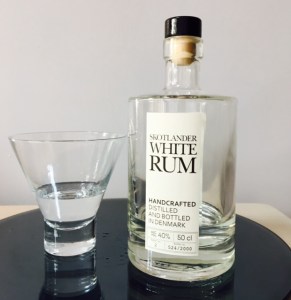
So it isn’t cheap.  The bottle is a stubby, slightly angular affair with a synthetic plastic topped cork Skotlander White Rum Review by the fat rum piratestopper.  It’s sleek and very modern looking.  The appearance of their rums runs right through their range.  Perhaps a few more colours could be used to distiniguish some of their limited editions from each other.  It can be a little confusing at times. That said the presentation is spot on and very modern.

In the glass Skotlander White is a completely clear distillate.

The nose isn’t as punchy as I thought it might be. It’s quite muted in some respects. It doesn’t jump out at you as I was expecting. I was expecting full on Pot Still insanity.

Having said that what is there is on the nose is very pleasant. Notes of vanilla, some spicy white pepper and a hint of mixed berries. It’s fresh and quite fruity but it takes quite a lot of nosing to get all the notes.

Sipped Skotlander White is quite fiery – there is a lot of white pepper and a nice burn of alcohol which I always enjoy with my spirits. It’s clean and fresh but again it does feel just a touch muted.

With a little more time on the palate it does show a few fruity notes – a little banana, some cherry and some coconut. There is a hint of aniseed in the finish and the mid palate.

The finish is quite long and satisfying. Nice notes of licorice again and a reasonable amount of “booze”.

Mixed as you would expect of white rum it does quite well. It’s not an overpowering white rum so it rubs along nicely alongside most mixers such as cola, ginger beer and lemonade. It adds a nice sweetness of stoned fruits and berries.

I’ve been tasting at a lot of white rums recently. This one I woulSkotlander White Rum Review by the fat rum pirated say is definitely above average. At its price point though, there is a lot of competition. It is quite a refined yet still fairly fiery white but (and I don’t often say this) I do feel it would have benefitted from a higher ABV.
A touch more beef to this one, would have been really interesting to try. Skotlander have a number of other rums in their portfolio so I will be having another look on their site soon. There is a limited edition white which is catching my eye.

It’s an interesting time for rum and people are increasingly looking for variety and something a bit different. It’s certainly a massive improvement on A.H Riise that’s for sure. There are no additives to be found in this rum.

At 50% ABV this one really might be even better….


Similar Posts

  • Mount Gay Eclipse Heritage Blend Barbados Rum

    Mount Gay Eclipse Heritage Blend Barbados Rum review by the fat rum pirateMount Gay Eclipse Heritage Blend Barbados Rum. This was one of the “first batch” of reviews that I published on this site back in March 2014, with an update to the review in 2015. Which might have involved the then new style bottle.

    It’s 2024 and the bottle (well the label) has once again been update to add “Heritage Blend” to the moniker and also to update the present Master Distiller/Blender Trudiann Branker.

    The old review will stay live on the website as I think its worth keeping the older reviews – I don’t often re-review rums.

    The price of Eclipse as with just about everything else in the UK, has crept up over the past few years. Its went from around £15 per 70cl bottle to around £20 now in most places. I picked up a few bottles of this Duty Free at £13.75 per 1 litre bottle.

    In my original review I wasn’t a great fan of this rum. I don’t often buy it to be honest but there wasn’t much else in the Duty Free. It’ll do as a weekend mixer. From my hazy recollection this was more forgettable than out and out bad.

    In my original review, I seemed to be under the impression this was 100% pot still rum, its not of course its a blend of column and pot still rum. Mount Gay Eclipse Heritage Blend Barbados Rum is aged in ex-bourbon barrels for around 2-3 years.

    As with all continuous releases – the rum will change over time as it is nigh on impossible to produce exactly the same rum year in year out. Since my review we have also seen a change in the Master Distiller/Blender. To be fair Trudiann has put her stamp on other Mount Gay Rum’s – XO and especially Black Barrel so I might well find myself with something quite different to the bottling I previously reviewed.

    It also should be noted that I am now in my mid forties rather than my thirties and much further along in my Rum Journey.Mount Gay Eclipse Heritage Blend Barbados Rum review by the fat rum pirate

    Mount Gay Eclipse Heritage Blend Barbados Rum is a classic “Gold” rum in colour when poured in the glass. A bit of orange around the edges and a nice golden brown colour with a slight shimmer.

    Not that I really give much of a toss about the colour to be fair….

    Nosing Mount Gay Eclipse Heritage Blend Barbados Rum is a gentler much mellower experience than I remember. It’s seems much less “harsh” and boozy. I recall an almost chemical like note from back in the day, which seems to have disappeared in the 2024. vintage.

    There is a nice top note of coconut and banana. There are lighter notes of vanilla and bourbon like aromas but again it doesn’t seem a whisky (as in Scotch) like as before. Definitely more of a Bourbon/American Whiskey note.

    There’s not a huge amount going on with the nose beyond the more obvious notes outlined above – maybe a little green apple and hint of toffee. The nose is pleasant enough though and certainly complex enough for a £20 mixing rum.

    I’ll try this as a sipper and a mixer.

    When sipped Mount Gay Eclipse Heritage Blend Barbados Rum is pretty light. Not as harsh or as heavy as I remember. Either it has mellowed or my taste buds have changed after 10 years. Likely a bit of both. It’ doesn’t taste especially young or rough. All round it is best described as agreeable.

    It’s a little bit “thin” if I’m being honest. I’m usually okay with 40% ABV rum but as sipper this definitely tastes a little watery.

    Complexity wise again it is okay – it delivers an initial bite followed by lots of vanilla. It’s short and quickly loses flavour in the mouth. Mount Gay Eclipse Heritage Blend Barbados Rum review by the fat rum pirate

    Overall its reasonably sweet and it is smooth enough to sip but pretty average really. A couple of glasses and I think I might get a little bored.

    As a mixer it does a decent job of adding some “rummyness” to mixed drinks. It makes perfectly serviceable rum and cokes etc but it doesn’t really stand out all that much.

    Overall I do like this bottling more than I recall from previous interactions with Mount Gay Eclipse. It still doesn’t grab me the way the “entry level” Jamaican rums from Appleton and Worthy Park do. Nor do I find it something that I would regularly pick up. Even on a Supermarket run there are rums I would pick ahead of it.


  • Black Tot Rum Last Consignment British Royal Naval Rum

    Black Tot Last Consignment British Royal Naval Rum Review by the fat rum pirateBlack Tot Rum Last Consignment British Royal Naval Rum. This is the fourth release from Elixir Distillers in their “Black Tot” series that I have reviewed. It was, however the first one they released. Pretty much as long as I started to get quite serious about rum I’ve known about this mythical (and expensive) bottling.

    It seems to have been released in batches over the years. I guess to try and drive demand partly keeping it looking more limited than perhaps it was. That said the current £750 price tag will put a lot of people off. It’s simply just too expensive for a lot of people to justify even if they could afford it. I certainly know I have my limit when it comes to what I can justify paying for a bottle of booze and it falls way below £750.

    Black Tot Rum Last Consignment British Royal Naval Rum is a blend of various flagons of genuine Navy rum (pre-dating Black Tot Day), which as a result of Black Tot day were never bottled by the Royal British Navy. Sukhinder Singh of The Whisky Exchange and avid collector of fine and rare spirits bought as many of these flagons as he could find. Noticing the differences between each flagon he set about perfecting a blend which best encapsulated British Royal Navy Rum.

    The Retail Price keeps increasing you can still pick up at bottle at The Whisky Exchange and at Master of Malt. As well as the stubby opaque bottle full of rum, complete with a chunky embossed cork stopper you also get a Tot cup, similar to those used in the days of daily rum rations, a wooden display case, a rum ration card and a book about the history of Black Tot, written by rum expert Dave Broom.

    Black Tot Last Consignment British Royal Naval Rum Review by the fat rum pirate

    The exact make up of this rum is unknown and numerous different types of barrels are noted as being used to house the various rums. Which in turn were contained within the various different flagons. It’s a fair guess to say that a lot of the rums will come from familiar “English Style” rum destinations, such as Trinidad, Jamaica, Barbados and Guyana. Whilst the actual age of these rums is clearly pre-1970, the rum has not been aged in wood as the flagons used to store the rums from 1970 onwards are ceramic.

    Black Tot Last Consignment British Royal Naval Rum is bottled at 54.3%, which is pretty much “Gunpowder” strength. I’m not going to bore you all with an essay about gunpowder strength or give you a history lesson on Navy Rum. This is a rum review so we’ll crack on with that……

    In the glass we have a very dark spirit. I would suggest some caramel colouring was added at some stage. It is a dark brown colour with a reddish/orange hue.

    The nose is musty. It smells a little “old”. Black Tot Last Consignment British Royal Naval Rum has a tarry character initially. Some diesel oil and some road tar. A touch of sweetness comes through in the form of raisins, red grapes and a touch of black banana. A touch of black cherry also comes through.

    It’s complex and you keep getting different aromas with each nosing. It’s quite smoky and has a very leathery aroma to it as well.

    Sipped it is very smoky on the initial sip with a very tarry and musty flavour to it. It’s musty and again feels “old”. It’s not as fruity as I might have hoped for. The influence of the Caroni rum in the blend is quite evident as is the Guyanese elements. However the Guyanese elements are adding a more musty aniseeed note than the usual sweet raisin profile.

    Further sips reveal a slight burnt smokiness and some hints of banana, guava and some rusty metal (?

    Black Tot Last Consignment British Royal Naval Rum Review by the fat rum pirate

    ). It’s a hard rum to try and describe. It’s quite bitter in parts and it isn’t the easiest of rums to come to terms with.

    However, a few sips in I’m starting to get more fruitiness – raisins, plums and some tannic red grapes. Especially on the mid palate.

    The finish is a reasonable length but is quite dry and doesn’t linger for as long as you might expect from such a heavy style of rum.

    What you are tasting here is a snapshot in time. Something that cannot really be repeated. Were the Royal British Navy still getting a rum ration, I dare say it perhaps wouldn’t be as good quality as this is.


  • Bedford Park Single Barrel Fiji Rum Aged 19 Years

    Bedford Park Single Barrel Fiji Rum Aged 19 Years review by the fat rum pirateBedford Park Single Barrel Fiji Rum Aged 19 Years. When Maison Ferrand teamed up with the Rum Co. of Fiji (South Pacific Distillery) a few years back, I was concerned about the future of Independently bottled Fijian rum.

    So far, there has been little change. Whilst Planteray have released their own take on Fijian rums, Independent bottlers are still consistently releasing quality products from the distillery.

    Today is Indie bottler Bedford Park’s turn. With one of the oldest Fijian bottlings I have came across so far.

    Bedford Park Single Barrel Fiji Rum Aged 19 Years is a 100% Pot Still Molasses based Rum. Distilled in 2004 at the South Pacific Distillery. The rum was aged in an ex-bourbon barrel until 2016.

    At which point it was moved to ex-rum cask (which will most likely be an ex-bourbon barrel!)

    It was bottled in 2024. Noted as being Cask Number 15. Which yielded just 223 bottles at 57.6% ABV. It is non-chill filtered with no additives.

    Availability of Bedford Park Spirits bottling is often split between Europe and North America. I’ve noticed the odd bottle for sale on Auction sites as well. In the US try Raising Glasses where it retails at $200. For Europe Bedford Park’s “own” website (ran by North Point Distillery) has it for sale at £120. They could do with separating their whiskies and rums or adding a search engine to make things easier to find.

    The artwork on the Bedford Park Spirits bottlings are particularly interesting. I’m sure you will agree. Certainly more interesting than some of the more austere European bottlers. This label was designed by The label is designed by Toronto-based artist Elise Conlin, whose early work while studying at the Ontario College of Art & Design caught their eye. Elise agreed to lend her talents to a series of labels, aptly named “Shady Grove”, for their first releases.

    In the glass Bedford Park Single Barrel Fiji Rum Aged 19 Years iBedford Park Single Barrel Fiji Rum Aged 19 Years review by the fat rum pirates a dark brown colour with a slightly reddish/orange hue. (I feel I write this a lot!)

    On the nose its quite grassy and floral. Not dis-similar to an aged Agricole Rhum. There is a slight hint of petrol on the nose and some more medicinal notes as well. Theres an almost floral sweetness running through it. Floral Gums (gum sweets) and a saccharin like note.

    It’s pleasant if slightly underwhelming. There is no sign of the more unpolished and fiery notes you often find with single digit Fijian rum.

    On the sip it is again quite sweet and a little on the floral side. Peach and Strawberry alongside a slightly perfumed note come through initially. It has a slightly oily mouthfeel which I enjoy

    Further sips reveal some very little tar and some slight petrol like notes. These are fairly faint though. As we move into the mid palate the rum begins to bear its teeth a little more.

    It’s spicier with some nice ginger heat and some cloves. There is a medicinal feel to the rum as the sweeter notes dissipate a little.

    The finish is a reasonable length and offers a nice mixture of spice and sweetness which fade out to leave a slight grassiness behind.

    I’ve compared Fijian rum to Caroni’s output in the past. For those of you looking for something akin to that then I would advise looking for something younger. Fijian rum is perhaps the distillate which seems to change the most in the Rum World. Especiallly Bedford Park Single Barrel Fiji Rum Aged 19 Years review by the fat rum piratewhen we get into the higher teens in terms of age.

    It would be unfair to say this is a sweet easy going sipper – without giving that some context. It’s certainly not a Zacapa or a Diplomatico style rum. It is probably more similar to an aged Foursquare in terms of profile.

    I like this quite a bit but I’m pleased to have had chance to try it before buying it. I would have expected more oomph from a Fiji rum if I had bought it blind.

    Another very good bottling from Bedford Park. Just maybe not what you might have expected.


  • An Interview with Kit Carruthers – Ninefold Distillery

    An Interview with Kit Carruthers - Ninefold Distillery by the fat rum pirateAn Interview with Kit Carruthers – Ninefold Distillery.

    The Ninefold Distillery has only been active for just over a year. I have gotten to know Kit over the past year or so, through other Scottish Rum Producers such as Ross Bradley (Sugar House Rum) and Collin Van Schayk (J. Gow Rum).

    Between them they are producing some of the best “home grown” rum in the British Isles. I have reviewed rum from all three of the above brands. I would heartily recommend reading over my reviews and perhaps picking up a bottle or two to try.

    As you will read Kit has a rather unique background and a quite unconventional route in to rum. Even prior to meeting Kit he sent samples out to a couple of us UK based rum enthusiasts with rather obscene names and asked us if we had tried “his….****”.

    1. Please give a brief introduction on yourself and your role in the rum world.

    I am the owner and distiller at Ninefold Distillery, a micro rum distillery in Dumfries & Galloway, Scotland. I make rum from scratch, using imported sugar cane molasses, so that means the fermentation, distillation, maturation and bottling are all done on site. Before I began distilling in 2019, I had no previous experience in the industry; I came from a background of geotechnical work and climate change research.

    2. Obviously, COVID-19 has been devastating to the hospitality industry, we cannot avoid this fact, it has had a huge impact on us all. How damaging has it been to your business and what have you done to try and minimise this?

    Being a very new business, trading only since July 2019, I was in some ways lucky enough not have built a large on-trade presence, so this side of the business is largely unaffected. I have been building relationships in the on-trade though, so on a personal level, it’s very difficult to see what’s happening and I’m extremely worried for the future of many on-trade businesses, that I love and respect out there.

    Where I’ve been hit the hardest has been the inability to attend events. As a small business, the face-to-face/meet the maker interactions with the public are crucial to building brand awareness and loyalty, as well as being the most profitable side of the business. Thankfully I’ve been able to secure a temporary license to sell directly to the public from the distillery, so this has helped mitigate the income loss somewhat. And I’ve been trying to do online live events to reach out to potential customers, and maintain relationships with my existing customers.

    To do my bit for the cause £1 of every bottle I sell through my website goes to Refuge, a charity for victims of domestic abuse, for the duration of the effective lockdown period. (Kit is being a bit coy about his charitable efforts here but all will be revealed at the end of this interview)


    3. What first attracted you to the Rum World? What were your first experiences with rum?

    I’ve never been much of a drinker, and definitely not spirits. Rum was, largely, an unknown to me, apart from the bottle of Appleton Estate V/X I brought back from Jamaica in 2004. That bottle, however, sat for years with barely a taste out of it; I just wasn’t that taken with it, and never sought to explore the broader category. So when I set up my rum distillery, it was at the time simply a business decision, based off the of the gin market and the potential to diversify the income of our family estate here in Dumfriesshire.

    However, cynical a decision that was to begin with, I quickly developed an appreciation for the spirit. There’s no way that I could have made my own rum if I didn’t appreciate the category as a whole. My goal, from very early on in the distillery, was to make rum authentically and honestly and that’s the overriding philosophy behind my brand.

    4. How do you think the Rum World has changed over the paAn Interview with Kit Carruthers - Ninefold Distillery by the fat rum piratest 5 years? Where do you see the Rum World in another 5 years? Where would you like to be in 5 years?

    As I’ve said, my knowledge of rum is very recent. And I largely focus my attentions on my direct competition, so other Scottish and British rums. In just the last 3 years, we have gone from a single Scottish rum brand, to at least 15.

    There’s been a very large upturn in new brands, myself included of course. Unfortunately some of these brands are less than authentic or honest about their products, and it leads to a muddying of the waters with consumers. I hope that in the next 5 years, the industry as a whole improves its transparency and honesty with consumers.

    In Scotland, we’re already trying to make inroads to educating consumers on what is, and isn’t, authentic Scottish rum to enable them to understand different styles of rum based on production methods, and ultimately to help them make more educated buying decisions.

    5. What is your stance on additives in rum? Would you like to see more Universal Regulation?

    Personally, I don’t have a problem if producers want to put additives in rum. But the caveat is that their products must be labelled as having been adulterated, and that ‘rum’ must be dropped from the label. I’m vehemently against producers trying to hoodwink consumers into thinking they’re buying rum, when in fact they’re buying a flavoured neutral spirit.

    6. Speaking of rules and regulations what is your opinion on the current issues over the Barbados/Jamaica rum GI proposals?

    I don’t follow this closely, and I don’t hold much of an opinion on it. Generally, though, I don’t see why G.I.’s need amending. Unless there’s a significant majority of producers clamouring for change, I would be suspicious as to the real reasons behind any lobbying for change from a single producer.

    7. How do you view your role within the Rum World? What do you hope to “bring” to the rum community? Do you reach out beyond your day job in rum?

    I’m here to make the best rum I can, while making a living of course, and be as honest and transparent as possible about my process.

    7. Do you actively use Social Media to reach out with other Rum Drinkers and Enthusiasts? If so where might we find you?

    Aside from posting on my distillery social media Facebook, Twitter, Instagram,I try and engage in othe

    r UK rum groups on Facebook. But running your own distillery doesn’t afford you much time for that, so I probably don’t engage as much as I’d like.

    8. Which rum producers are your current favourites?

    I don’t think I drink enough to have tried enough rums and develop a favourite brand. My current favourite on the shelf is the bottle of Hampden Estate 46%.

    9. Which rum producers/brands do you think are currently flying under the radar? Name 3 rums people may not have tried but really should give a go

    I try and beat the drum for other Scottish rum producers like Sugar House, J. Gow, and Matugga. They’re all wee brands, like myself, and now more than ever could do with as much support as possible.

    10. Finally, what is your idea of the perfect rum and/or rum drink/cocktail?

    Give me a well made daiquiri any day!

    So there you have it some refreshingly honest answers from Kit. Clearly though he is driven to make the best rum he can and without additives. Which is also a plus point here at thefatrumpirate.com

    Kit has also just opened up a competition to win some free rum, a distillery tour and a ride in a VW Beetle (Did we mention unconventional earlier?)

    Kit has also just revealed an opportunity to buy bottles of the first Cask Aged Rum from Ninefold Distillery with ALL proceeds going to two local charities.

    An Interview with Kit Carruthers - Ninefold Distillery by the fat rum pirate


  • Privateer International Letter of Marque Sisters in Arms TWE Exclusive

    Privateer International Letter of Marque Sisters in Arms rum review by the fat rum piratePrivateer International Letter of Marque Sisters in Arms TWE Exclusive. TWE for those who have are unaware is the commonly used abbreviation for The Whisky Exchange, which is increasingly focusing attention on rum. They have their own rum brand in the shape of The Black Tot and more and more of these “exclusive” rums are popping up.

    Very popular they are proving to be as well. The most recent offering a Hampden Estate VIREO 2010, sold out within hours. Unfortunately many of these consumers are not going to be imbibers of these rums. Increasingly we are seeing people “flipping” bottles sometimes days (and often even before in certain European countries beginning with I) after they have went on sale.

    That is a discussion for another day, many rum collectors/drinkers see flipping as a legitimate way to obtain more hard to find bottles further down the line.

    Privateer Rum hasn’t been readily available here in the UK. In fairness it has only been sporadically available in mainland Europe. It’s main market has been the US. Now the US rum scene is quite different to Europe. I would also say that whilst us British can be reasonably patriotic (sadly often in a rather zenophobic manner) there is little doubt that the people of the US are much quicker to back their own homegrown products. In quite a vociferous manner. I’ve no problem with this I must add. It’s not a criticism

    However, overall the quality of rum available to your average European is better, I would say.

    For a few years now Maggie Campbell, President, Head Distiller or Master Distiller depending on what sources you read has been the poster girl for Privateer Rum. She has built a reputation for opposing the use of additives and has given numerous talks and attended numerous rum festivals to share her knowledge.

    In rum circles Maggie is well respected and well liked by her peers. In many ways as with other operations that have deployed females in Senior Positions, within their Rum Organisations such as Appleton Estate and Mount Gay, it seems to add further interest.

    So demand for this TWE Exclusive was always going to be high. Despite my best efforts (should I start writing a review every day?) if you want to try this particular rum then it’s going to be the secondary market I’m afraid. Sorry……no hang on hold your beer……..you can still pick up some samples as well as a bottle of Privateer Navy Yard from TWE if you wish to try their rum.

    Privateer International Letter of Marque Sisters in Arms rum review by the fat rum pirateAnyway, lets talk a little about what was available in this bottle. Privateer Letter of Marque Sisters in Arms TWE Exclusive is noted as being a “Single Traditional Column Still” rum. However, from what I understand Privateer often carry out Double Distillation whereby they run the rum through a Pot Still and then through a Column (not a continuous column its still batch distillation). It is also thought that they might have a kind of hybrid still.

    I’ll be perfectly honest I’ve sat down on numerous occasions to try and understand distillation and how it works etc. Very little tends to stick. I just can’t get interested! Apologies that probably makes me a bit of an oddity in the enthusiast world.

    Privateer International Letter of Marque Sister in Arms has been aged for 3 years in a “Used Rum barrel”. It has been bottled at 57.5% ABV and retailed at £74.95. An outturn of just 220 bottles – single cask. The rum is presented in the familiar (well if you are familiar with Privateers rums to begin with) tall thin bottle with a simple black and white colour scheme outlining various information about the bottling. It uses a “handwriting” style typeface for the title etc. It’s interesting but they have bottled a lot of rum in very similar bottles – so keep an eye on what you are buying.

    So let’s see how this compares to the previous Privateer bottlings I have tried.

    In the glass the rum is a light golden brown. Nosing you are struck by a waft of vanilla and baking spices. Some icing sugar and a big hit of oak spice (very aged bourbon-esque) and some stewed tea. It’s both sweet and quite woody at the same time.

    Sipped it is very spicy on the initial mouthful. Full of vibrant oak spice and as mentioned already its also quite heavy on the vanilla. It reminds me a little of English Harbour from Antiqua. I would say it’s a bit heavier than a typical Foursquare offering at a similar age in terms of the wood and spice. They do share certain similarities though.

    It does benefit from some time in the glass. I’d recommend this to allow some of the woodiness to dissipate a little. I wondered at first if this had been aged in Virgin Oak.Privateer International Letter of Marque Sisters in Arms rum review by the fat rum pirate

    The mid palate moves into a fruitier profile with some banana and a touch of raisin. It’s still quite spicy though – white pepper, some cumin and a touch of chilli.

    The finish holds up quite nicely and doesn’t get as spicy or as oaked as I was expecting. The vanilla makes a re-appearance. It is a touch on the short side though maybe that is not a surprise for a relatively young rum.

    All in all this probably wouldn’t be your best bang for buck, when it comes to a Privateer. That said availability here is problematic at present.

    Privateer International Letter of Marque Sisters in Arms TWE Exclusive, is a nicely put together rum, no question. As it’s already quite woody I’m not sure if it would benefit from more time in the cask, really. Still I have a few more Privateer’s to review – I’ve kindly been sent some from the US.


  • Cachaca Santa Terezinha Arte

    Cachaca Santa Terezinha Rum Review by the fat rum pirateCachaca Santa Terezinha has been produced in Marechal Floriano, Espirito Santo since 1943. It is a young white Cachaca with minimal ageing. The brand work with Brasillian artists to create their distinctive labelling and packaging.

    It is aged in Cerejeira casks, for 6 months. Cerejeira is a wood Native to Brasil. Which gives the Cachaca its distinictive character.To produce Santa Terezinha a 50/50 mix of boiled sugar-cane “broth” and cold broth is fermented for 4 to 5 days with toasted bagasse and a handful of corn-flour. Whilst this broth is fermenting a fire is set up in the same room where orange or tangerine leaves are burned.

    The fermented broth is transferred into metal tanks for a further 5 days to develop into a “mash”. It is then fed into the water-cooled copper still and the resulting distillate is the Santa Terezinha Cachaca Arte. Once the Cachaca is distiled it is aged in the Cerejeira wood for 6 months.

    Presentation wise Cachaca Santa Terezinha Arte is very “Brasillian” bright colours – reds, yellows and greens. Their labels are created by Brasillian artists such as Helio Coelho and Haroldo Busotti. You will note from the photos that the label states “Serie Artes”. Cachaca Santa Terezinha is bottled at 43% ABV the producer states that the Cachaca works well with food such as Chicken and Fish dishes.

    I apologise for using information direct from the producer. Its not my usual style but it is difficult finding any information written in English. I cannot find anything which will reliably translate Portuguese in a satisfactory manner.

    In the glass Cachaca Santa Terezinha Arte is very slightly off-white – slightly lighter than white wine even but there is a tinge of colour.

    Nosed this cachaca is quite vegetal and grassy. Freshly mowed fields, fresh sugar cane. This reminds me more of the white Cachaca’s I have tried in the past. Rather than some of the more aged Cachaca’s I have more recently.

    It’s fresh and nicely defined though it doesn’t smell quite as “boozy” or as “industrial” as some of the brands found in the UK. There is a nice perfumed/flowery note – again coming from the native wood which I am really growing accustomed to and really growing to like!

    It’s quite sweet on the nose but quite potent nonetheless.

    Sipped it is surprisingly complex and goes down nicely. It’s surprisingly smooth and quite easy-going. The initial burst is quite spicy – perfumed wood, ginger, notes of vanilla and a nice sweet/sour hit at the back of the throat.Cachaca Santa Terezinha Rum Review by the fat rum pirate

    It shows its relative youth in the mid palate and finish which whilst not short – fades quite quickly to little more than a residual burn.

    Again this is a very approachable and easy to drink spririt. It works very nicely with lemonade or even soda water. Cola is perhaps not a good option but its still quite a tasty “vegetal” take on a “rum” and cola.

    A Caiprinha is perhaps the best use for this Cachaca. As a sipper it is good but just comes up short overall. You would like to savour it a bit more in the mouth but much of the intiial complex burst of grassy notes, vanilla and the perfumed wood doesn’t last long enough, to really enjoy them. An aged Santa Terezinha? I’d be keen to try that and there are other Cachaca’s in their range.

    I notice a slight difference between this and the Cachaca Fuzue and Mandaguahy. The wood seems to be to be a touch lighter. Imparting a little less overall, in terms of  flavour. Having said that, it could be due to the time in the cask as well. This is something I will learn over time. This forage into Cachaca is very much a learning curve. One which I am happy enough to share with you all but please take my notes with a pinch of salt!

    I enjoyed this one overall but its perhaps best used as a mixer.