Lost Years Four Island Rum

Lost Years Four Island Rum review by the fat rum pirateLost Years Four Island Rum. Up for review today is another offering from Turtle Savers Lost Years. This rum follows on from my review of their Navy Strength Rum a few weeks ago.

Lost Years Four Island Rum as the name suggests is a blend of rums (yes you’ve guessed it) from four different Caribbean Islands.

Firstly the blend is a little unusual in that it is a mixture of both molasses based and sugar cane juice r(h)ums. We have an 8 year old rum from Foursquare Rum Distillery, Barbados alongside a 5 year old rum from the Dominican Republic, 2 year old pot still rum from Jamaica and finally some unaged white agricole rhum from Guadeloupe.

The Lost Years website notes that no additives or colouring has been used in the blend. The additives bit I can confirm via a clean Hydrometer test.

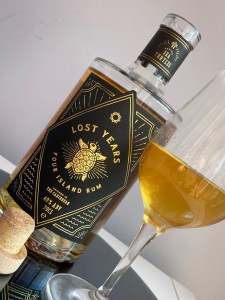
Presentation wise Lost Years Four Island Rum comes in a short necked,rounded stubby bottle with a natural cork wooden topped stopper. The branding is clean and modern. The rear label gives the information on the blend and other relevant information relating to the rum and their work with the Sea Turtles. Expect to pay around £38. It is bottled at 40% ABV. Lost Years Four Island Rum is currently in stock at The Whisky Exchange and Master of Malt or you can buy direct from the Lost Years website.

I’ve mentioned already that “blended” rum seems to have made a bit of a comeback over the past couple of years. New brands from the UK in particular have been popping up with great regularity. Especially at a similar price point to this rum. So lets see how it stacks up against the competiton…….

In the glass Lost Years Four Island Rum is light/golden brown. The nose is surprisingly robust. Lots of oak, tobacco and some underlying funk and grassiness which adds an extra layer to the nose.

Further nosing reveals some light toffee, banana and papaya. The Guadeloupe element shows itself in the shape of a sweet, grassy aroma. Hints of vanilla float in and out of the mix. I get some green apple and some smokiness as well.

Lost Years Four Island Rum review by the fat rum pirateAll in all its a very interesting nose. The profile overall is quite “dry” and you can really notice the barrel influence but that is balanced by the sweeter rum from Guadeloupe and the Dominican Republic.

As a sipper Lost Years Four Island Rum is surprisingly rounded it has a really nice balance. Even at 40% ABV it is still quite “punchy” and has a nice weight to it. The oak and spices work nicely alongside the fruitier elements in the blend.

My concern was that the Guadeloupe rhum might have dominated the mix. Maybe caused it to develop to the point, where the other rums were lost. That hasn’t happened. The Guadeloupe rhum sits nicely within the blend and doesn’t make is taste “odd” – like you might expect.

The initial sip is quite woody and dry but further sips reveal more of the fruitier and sweeter notes of the blend. Toffee and caramel mingle alongside the oak spices and the tobacco notes on the initial entry.

On the mid palate the Lost Years Four Island rum becomes fruitier with more sweetness. Some grassy funk comes in with plenty green apple, banana and a touch of raisin. It has a really nice balance to it and everything works together nicely.

As a sipper possibly due partly to the ABV and the use of some younger rums – the finish isn’t quite as long as you might like. That said it has a very nice, clean finish which fades out gently. The flavour does disappear a little quicker than I would like though.
Lost Years Four Island Rum review by the fat rum pirate

Lost Years Four Island Rum is at a price point where I would still consider using it as a “Premium Mixer”. It makes for a really interesting and quite different rum and coke. I would also imagine that due to the different rums used in the blend that a talented mixologist could find a lot of uses for this particular blend. It could work as a shortcut to using 2 or 3 different rums?

Lost Years Four Island Rum is a very nice “everyday” kind of sipper. That said it’s not what I would call soft or overly easy going. It’s still quite a “rummy” rum – ie it still has a bit of “menace” about it.

It’s not quite as good as their excellent Navy Strength Rum but its still more than decent. Certainly well worth the price.


Similar Posts

  • Cane Island Dominican Republic Aged 5 Years

    CANE ISLAND DOMINICAN REPUBLIC RUM AGED 5 Years rum review by the fat rum pirateCane Island Dominican Republic Aged 5 Years is the final review in the recently released trio of rums from Cane Island.

    As mentioned previously Cane Island are a new Independent bottler – at the moment their rums are only available from shops in Amsterdam.  Luckily most of these stores deliver to the UK so I didn’t miss out on trying these rums.

    For me when it comes to Independent bottlings it seems that Demerara, Caroni (Trinidad) and Jamaican rums are the most popular offerings.  There are perhaps a few reasons for this – DDL do not release many rums that do not have additives – a gap in the market which Velier expertly exploited which heightened peoples awareness of Demerara rum without additives.  Velier were also in the favourable position of being able to have their rums aged in Guyana – unlike the rest of the competition.

    Even said European aged Demerara is still very popular.  The myth that is built around the Caroni distillery and their “heavy” style rums ensures their enduring popularity.  Jamaican rum is popular because Appleton apart none of the Jamaican rum distilleries release many aged products.  So if you want aged Hampden or Long Pond rums you must buy independently.  The likes of Monymusk and Worthy Park are moving into the aged market.

    So this makes a couple of Cane Island’s releases a little more interesting.  Especially this one.  Rums from the Dominican Republic are very popular especially in Spain.  Brands such as Brugal, Bermudez and Barceló are well known and well recognised.  Oliver & Oliver also have numerous bottlings available in numerous guises.

    Very few indie bottlers have put out any Dominican rum.  This rum is aged for 5 years and has been column distilled at “Alcoholes Finos Dominicanos” the distillery location noted on the bottle is “San Pedro de Macoris”.  Which is the distillery which produces the Ron Barceló brand amongst others.

    The rum from the Dominican Republic is produced in the “latin” style additives and adulteration take many different forms and information is hard to come by.  The hydrometer reveals 12g/L of “additives” in this rum.  It is likely this rum will be a light, approachable and sweet rum.

    A 70cl bottle will cost around 40 euros – again slightly more expensive than the branded equivalent.   It should be noted though that the likes of Brugal. Barceló and Bermudez do not note ages of their rums..

    The rum is noted as being column distilled and aged in American Oak (Bourbon) barrels.  No details of any “finish” or second maturation are noted.

    In the glass the rum is a little dull – its not a particularly vibrant colour, it looks a little washed out.  It’s an ungolden brown.

    The nose is not overly impressive either.  It’s quite muted and I’m not getting a great deal from it.  There is a slight sweetness to it.  It smells a little Cuban.  It’s very light and easy going.  There is nothing offensive about it but at the same time nothing exciting either. It has a slightly floral note lurking in the background.

    When sipped it initially is quite “boozy”.  It’s youthful and the alcohol really comes out.  Further sips reveal more of the sweetness hinted at on the nose.  It’s a very familiar rum – it reminds me of Botran or a younger Panama rum.  It is not as sweet and as layered with chocolate notes, like Barceló Imperial nor is it is a dry and briny as Brugal.

    Although the nose and appearance were a little disappointing its not an unpleasant experience sipping this rum.  At 5 years old it still has some of the youthful alcohol notes.  I enjoy these as they make it more “rummy”.  This make it less generic than some of the lighter column distilled rums from this part of the world.

    It’s not massively sweet and is quite dry (especially on the finish).  It also has some nice spicy oak. A good deal of interaction with the barrel giving it some sweet/sour notes.

    It’s a light latin style rum but its not afraid to show its teeth.  I wouldn’t call it particularly meaty or complex but it does have a bit of a twist and an extra dimension.  It’s easy to drink but it does give you a little bit of a kick.

    All in all much better than I had imagined.

  • Gargano Rum Classification – Can it Change the Rum World?

    Gargano Rum Classification Article by the fat rum pirate Hampden StillIntroduction

    I’ve been asked a few times recently why I’m not supporting the Gargano Rum Classification.  By support, I assume people are wondering why I haven’t featured the classification on the site? Or why I haven’t adopted it in my reviews?

    Fact is, I have for a long time tried whenever possible to find out how the rum in my bottle has been produced.  Which is exactly what the Gargano Rum Classification involves. Though I haven’t “come out” in favour quite as enthusiastically or as quickly as some, the more information disclosed the better in my book.

    Background

    The Gargano Rum Classification system has been drawn up in conjunction with Barbados rum producer and Master Distiller Richard Seale by Luca Gargano of Velier. Both Velier and Foursquare have put out some of, if not the best rum over the past 20 years and beyond. Velier recently celebrated its 70th birthday. Richard Seale is a third generation master distiller. Anything these two are involved in is usually for the good of rum.

    Initial Thoughts

    If you are like me you tend not to take things at face value and just agree with everything.  Some may consider me to be cynical. I see this more of being realistic.  I don’t believe in fairies and unicorns.  I tend to dig deeper into things.  Not only do I read what is put in front of me. I also consider the implications of what is being presented. In effect I map peoples ideas through to the logical conclusion(s).  Or rather what I think the logical conclusion will be.  I will mention at this stage that I have asked Richard a few questions regarding the classification. I’m not flying blind with some of my opinions.

    In order for me to justify and explain my thoughts on the Gargano Classification I will take you through a few prior attempts at classifying rum, as well as this proposed system.

    I say proposed, even though it is already being used. Velier/Habitation Velier and Foursquare have adopted the classification and others are also working towards it. As it stands it has not been adopted by many producers. It  is still in a pretty embryonic stage.

    Rum Flavour MapThe Rum Flavour Map

    In 2015 a Rum Flavour Map started popping up all over the internet.  It was it claimed similar to that used to classify Scotch Whisky.  The map was produced by Spiridom.

    “Spiridom is a joint venture between leading rhum brands from Guadeloupe, Rhum Damoiseau, and Martinique, Rhum Clement and Rhum J.M. Founded in 2005, the company is responsible for the distribution and development of Rhum Clement, Rhum J.M and Rhum Damoiseau in France and around the world.”

    The Rum Flavour Map basically tossed all the rum in the world into just three categories – French, English and Spanish style.  It in now way differentiates between Pot and Column production.  Nor does it account for blends from different islands and styles.

    I accept that classifying rum is tricky.  I have a Rum Styles page on the site which fails to identify every kind of rum and it has seven or eight categories!  It’s not really the lack of categories that annoyed me about this system.

    As noted already Spiridom represent producers from the French category.  Now take a look at the flavour map and look at the adjectives used to describe the French style in comparison to the Spanish and English styles.  Words such as oily, lighter, spiced and dark are not there to be complimentary.

    Unfortunately the Rum Flavour Map went a step further than this and re-inforced its very biased view by describing molasses based rum in the most unflattering way possible – Industrial or as even the French don’t actually really call it Rhum Industriel.

    This was a poor effort designed to elevate Rhum Agricole at the expense of other rums.

    Hold that thought about Industrial rum though.

    Best in Class RumXP Tasting Competition 2017 by the fat rum pirateClassification in Competition

    Just about every bottle of rum on the market could have an award from the various tasting competitions that are held all around the world.  There are so many competitions and as a consequence so many categories used.

    In the main rums are “classified” on age and/or colour.  Occasionally they are judged by geography as well as age. More often than not though a 10 Year Old rum from Barbados will be put in direct competition against a 15 year old Solera rum from Panama or a funky Pot Still Jamaican rum will find itself judged alongside an Agricole rhum.

    Judging a rum by its colour is an utter nonsense in a world were rum is rarely bottled at natural colour.  Age is an indicator and gives the consumer an expectation level but you shouldn’t really judge whether a 15 Year Old Jamaican rum is better than a 15 Year Old Demerara. Apples and Pears.

    An utter nonsense and a complete mess.

    Classification by Writers, Bloggers and Journalists

    A lot of rum writers have tried to “nail” down rum using categories etc.  Again this has taken on numerous guises.  Colour, age, Geography have all been tried with varying success.  In Dave Broom’s Rum The Manual he tries to plot numerous rums in a X and Y style axis.  Its a scattered approach and once again – its not perfect. Again I have a page called Rum Styles which seeks to identify the most common types of rum by method based mostly on Geography.  It is a start but again it is not perfect.

    Having said that it is a lot better than some efforts.  Especially those written by people with little interest or knowledge of rum.  We’ll leave those well alone though.

    Foursquare 2013 Pure Single rum Habitation Velier Rum review by the fat rum pirat

    So with many attempts to classify rum in the past – What has Luca Gargano proposed?

    Gargano Rum Classification – Categories

    Rather than use colour, age or even Geography Luca has opted for a much simpler approach based on the method of production.  Which is something from looking into the subject that has not been seriously considered or implemented before.

    The system is relatively simple rum is classified in the following manner

    Pure Single Rum – Molasses 100% Batch Pot Still Distillation
    Pure Single Agricole Rhum – Cane Juice 100% Batch Pot Still Distillation
    Single Blended Rum –  Blend of 100% Traditional Column and Pot Still rums

    Traditional Rum – Traditional 100% Column Still Distillation
    Modern Rum – Modern / Industrial Multi-Column Distillation

    Pure = 100% Pot Still rum
    Single = 100% Single Distillery rum

    Thoughts/Conclusions

    As you can see the classification groups rums by production method.  Like Scotch Whisky it differentiates between blended product and single – in this instance though using distillery not malt.

    Which is really my first misgiving about the system.  Whether deliberate or not just like Scotch Whisky, it is in danger of creating a belief that Pure Single Rum with 100% Pot Still Distillation is the best.  Which in turn like Scotch Whisky will lead those who aren’t that well-informed to think that it is always the superior product.  Now I would say as an entry point into rum, 100% Pot Still rum is probably not the best place for most people to start their rum journey.

    It creates intentionally or not a hierachy.  It will give someone the belief that the quality of the rum goes down as you pass down the list.  Like I say this may not be intentional but unfortunately that will be how people will see it. It is how some people are already seeing it.

    Education will inform this but the belief that a Pure Single Rum that is 100% Pot Still batch is the “best” or the holy grail of rums is in my opinion and experience not always the case.

    Habitation Velier WP 502 Forsyths White Rum Review by the fat rum pirate Worthy ParkI really hope we aren’t looking to enter a world where Single Blended rum is no longer seen as an exceptionallly high quality product.  Moving further down the scheme of things even Modern Rum can be pretty damn tasty if we look to the likes of Don Q.

    Which moves me along to my next misgiving about the system – Modern Rum.  You may recall earlier I mentioned Industrial rum.  Well originally that is how this section was named – Industrial Rum.  Hardly flattering in any context I’m sure you will agree.  I am pleased to see that this moniker has been changed.

    Having said that I will still be surprised if producers of such rums will adopt the system.

    Another complaint regarding the classification (though not from me this time) is that it doesn’t cover everything.  Well it does and it doesn’t.  Straight up it seems to miss out blends from multiple distilleries.  So rums such as Pussers Gunpowder might struggle to get a “classificiation”.  I’d question whether such rums really need it to be honest.

    I would say it is in the hands of producers to decide if they wish to adopt the classification and then decide how they feel their rum fits.  I am not advocating at this stage they just make it up ie claiming Pure Single Rum when its modern.  Maybe the producers need to work with Luca to further develop and tweak the classification?

    So what do I see on the plus side of the Gargano Classification?

    Well the obvious one for me will be the availability of more information regarding the rum in the bottle.  Which from my point of view is a huge step forward.  In terms of transferring information across to my readers the Habitation Velier bottlings have been a god send.  The information contained on this bottlings is first rate and exactly what enthusiasts want.

    To categorise rum by production method is absolutely the correct thing to do in my opinion.

    It is also worth noting that whilst the classification doesn’t mention additives (such as sugar added post distillation) wherever 100% is used in the classification it means just that. So if you have added anything (barring water for proofing reasons) to your rum it must be placed in the Modern Rum category. This is a point which is very clear – once it has been pointed out to you. In my case Richard Seale made this (now obvious) point clear to me. Again, I am in favour of this

    I also consider something else which  may be seen as a downside to many to actually being a source of strength for the classification.

    The Big Boys won’t use it.

    Yip that’s what I said – The Big Boys won’t use it.  Even taking the Industrial moniker away and replacing it with Modern Rum I still do not think the likes of Bacardi and Diageo will adopt the classification.

    Now if you read many publications online you would automatically assume this would be a bad thing.  If (and this only an estimate) 90% of rums do not have the classification visible how will the system ever work?

    Well obviously if most producers don’t adopt the system then it will be globally less visible.  However, if you buy cheap mixers from the likes of Captain Morgan and Bacardi how long do they last? A couple of weekends? A month maybe?

    If you buy a more expensive rum how long will you keep it?  You’ll likely savour it – keep it for special occasions.  If you really like it you might rush out and buy a back up.  It’s likely you’ll hang onto the bottle considerably longer.  You’ll look at the bottle more, take in everything on it soon you’ll become familiar with “Pure Single Rum”.

    Next time you are in a store or shopping online you’ll start looking for “Pure Single Rum” or “Single Blended Rum”.  You might even ask if the store stocks any such rums.  When the clerk can’t answer your query (because his stock of big boy rum doesn’t give an answer) its likely you’ll leave the store empty handed.

    Once your curiosity has been piqued you will start to search for “Pure Single Rum” or “Single Blended Rum”.  If you cannot identify how a rum has been produced you will stop buying such rums. “Super Premium” just might not cut it if you can’t be told what is actually in the bottle.

    The key to the classification is that it is giving you information.  Thus educating and giving you a better understanding of rum.

    The fact is the success of this classification could be that the big boys don’t adopt it inadvertently guiding customers towards those producers who have.

    Now do not think this will involve any Rum snobbery either.  Foursquare bottlings in the £30-35 price range have begun denoting if they are Pure Single Rum or Single Blended Rum etc.

    The Big Boys continually use terms such as “Premium” and “Super Premium”.  How will these terms exist in a world where people are aware of the difference between Pure Single Rum and Modern rum?  Will we continue to see the likes of Bacardi thinking all they need to do is re-package the same multi column distilled rum and call it “Super Duper Premium”?

    Has the recent Facundo range really set the world alight?

    The next time they do a promotional article using the same old tricks will the Rum public be fooled or will we start asking more and more questions?

    You see that is where the pressure will be applied to adopt the system.  If the average consumer wants more information on what they are drinking.  It is very difficult and also stupid to ignore your audience.

    Of course it may pan out that the system has no influence.  Consumers will continue with their current buying habits.  I would say over the past few years there has definitely been an increase in awareness.  I believe this system will have an influence.  I’m not saying it will change the rum buying “habits” of every rum consumer but it will certainly sway some. I’m more than sure Velier and Foursquare bottlings will continue to sell very well in the future.Foursquare Rum Distillery Triptych Rum Review by the fat rum pirat

    Whilst any classification system will have its pro’s and con’s this system is by far the best system to elevate rum and to enable the consumer to actually understand what is in the bottle.

    No magic herb gardens, no ageing facilities in the clouds or under the sea, no tales of non-existent Pirates or Admirals – just simple cold hard facts based on how the spirit in your bottle was actually distilled.

    Couple this with additional information on the bottle regarding ageing and genuine age statements and what do you have? The potential for genuine Premium Rum to be recognised by every consumer.


  • Top Ten Best Rums in the World Ever, Ever (Part One)

    Havana Club Maximo Rum Review by the fat rum pirateSee what I did there? If it’s not yet apparent then what I have done with my title is infer that this article is going to include the ten greatest rums produced in the whole wide world ever……….

    It isn’t.  Instead, what it is going to do is run down the ten most annoying, outlandish, poorly researched or just plain lazy Click Bait pieces of so called journalism that have befallen our less than noble spirit over the past few years.  Articles which have reeled us all in with promises of hidden gems and new an enticing rum experiences.

    Anyone who contributes to the various Rum Communities on Facebook, Reddit and Google+ must have come across one of these lists and shook their head in disgust at the contents.  What I will say this isn’t a go at those people who have shared these posts.  I for one really enjoy these lists.  Not in an informative way but as a means to cut through the bullshit and hopefully give people a more reasoned sense of what the list was intended to do.  Please note these lists are very rarely intended to actually educate a rum consumer to make smarter purchases.

    This top ten will be made up of lists so bad they can be condemned in their entirety to mere snippets of marketing bollocks that have been (un)wittingly passed on by the journalist without questioning their validity and pretty much anything in between the two “stools”.

    So here we go with the first 5

    GAYOT10.  Top of the Google Search of “Best Rums in the World” comes Gayot.com (pronounced as they helpfully explain as guy-OH) tagline “the guide to the good life”.

    “The Flavour of the Islands” is beneath the articles tagline and they go to explain explain these are the top ten sipping rums (in the world)………

    To be honest this list isn’t at all bad (although I don’t think they have actually ranked the rums in any particular order).  The “click bait” 1-10 seems a liitle random and they don’t actively identify any rum as being the “best”. (I don’t think the 1-10 is really listing the rums in that order as such)

    One of the biggest issues with this list is the lack of genuine tasting notes, it just seems to be regurgitated marketing speak.

    However, the thing which really makes me question the credibility of this list is not just the inclusion of the Vizcaya 21 but the appearance of the ludicrously over-priced liqueur like Pyrat Cask 1623.  Also note no sign of any rum from Foursquare or an aged Rhum Agricole of any description.

    thestreet_logo_black_bg_front_lead9.  Next up is the “Ten Best Bottles of Rum in the World” once again quite a statement to make but clearly TheStreet know their stuff!

    Well actually no – they don’t but they have at least sought out some experts in the shape of the International Spirits and Wine Competition (ISWC).  The writer has also taken the time and effort to consult Wikipedia prior to writing the introduction.

    The problem with this list is that they seem to have picked ten random winners in the various rum categories at the ISWC awards  (it should be noted that budget Supermarkets Lidl and Aldi have their spirits judged and handed medals in these competitions as well).  The results?

    Rhum Neisson, 3 rums from Angostura, 1 from Rum Company (a rather interesting looking Guadaloupe Calvados finish), El Dorado 12, Havana Club Seleccion de Maestros, Inner Circle Green Dot (an Australian rum) and finally Appleton Estate 8 and 21.

    Hardly a balanced overview of the rum world but some interesting selections nonetheless.  The articles connecting to each rum are hardly inspiring.  Mostly marketing.  It might however provoke some interest in some decent and varied rum.

    Grab List

    8.  Grab List

    Indeed this particular list does have a very much “grabbed” feel about it.  This is not the Top Ten Rums in the world but the top ten brands.  The introductions is cringe worthy and reminiscent of a 12 year old’s school project type paper.

    The actual top ten are a pretty eclectic mix.  How the wrter Santosh Kumar has come up with this list I have absolutely no idea.  Take number 3 for example

    “3. Tilaknagar

    It is another Indian drinks company that really performs excellently in the field of alcoholic beverages. Madira is one of its top selling rum that made the company extremely famous all over the world.”

    I’m pretty sure it isn’t just my ignorance which means I have never heard of this rum nor the company responsible for it.  All I can think is it sells an awful lot in India.

    It’s also worth noting the Mohan Meakin are not featured in this to ten despite them being the second best sellers in India.  Interesting.

    This list has largely flew under the radar and to be honest it isn’t one of the worst I have seen.  It is rubbish and pretty much pointless but it is nowhere near as bad as some of the lists that are further down the rankings………..

    CRAVE7.  Next up are Crave Online 

    Now this article is exactly that, an article which explains why Rum is the New Whisky.  Now first of all the whole “converting whisky drinkers to rum” thing really pisses me off.  It shows exactly the kind of inferiority complex rum seems to suffer from.  “You should really try (insert random rum) if you like a nice bourbon”.  Piss Off!

    However the article takes an even more cynical turn and is basically Joy Spence from Appleton Estate trying to promote their rum via Crave Online.

    The only reason this doesn’t appear higher in the list is that strangely it doesn’t feature and photo’s of any Appleton rums and despite it being a bit of a “plug” most of what Spence says makes perfect sense.

    As the list goes on you will see there are for more cynical pieces of sheer advertising cheek being paraded around the net!

    6caribbean_journal_logoCaribbean Journal


    I’d usually expect better of Caribbean Journal.  Surely such a site should be able to come up with a decent list of quality rums, which have been well researched.  And I’m pretty sure they have done just that in the past.

    Unfortunately in this instance they have decided to focus on “American”  rums.  Again not a bad thing but lets have a closer look at what has been selected.

    First up to cause my eyebrows too twitch was the final line of the Siesta Key piece ” Siesta Key’s signature spiced blend is a gold-medal knockout that isn’t just the best in America — it’s better than any in the Caribbean, too.”  For something called Caribbean Journal to say that is some statement to make!

    Papa’s Pilar is up next.  Named after Ernest Hemingway’s boat the rum (especially the Dark 24) is a concoction hailing from many different corners of the Caribbean and beyond and with almost as many maturations and finishes.  It’s heavily sugared as well which should surprise no-one.

    However according to the research ” This is a blend of rums from around the US and the Caribbean, but it’s distilled right in America” I’m pretty sure I don’t need to say anything at this point.  One more educated commentator and fellow unfortunate reader of this article has asked how this works – needless to say he has had little by way of a valid answer thus far.  I wonder why…….

    Next up is one my particular favourite marketeers Lost Spirits Distillery.  According to the article as well as produce aged spirits in his reactors, Bryan can also produce Demerara rum in the US! Simply incredible!

    The rums featured in this article aren’t all bad but the lack of research beyond marketing lines is terrible.  I’d be surprised if the writer has even tasted any of the rums mentioned.

    So that completes our first five awful pieces of so called journalism.  I’ve every confidence that few people will have got a great deal out of any of the lists and many will be left as disenchanted as myself and many others around the Rum Community.

    Don’t be too concerned about these though.  They are just the tip of the Iceberg.  The next five (which will be published soon) are far, far worse………..


  • Alnwick Rum

    Alnwick Rum Spirit of Northumberland review by the Fat rum pirateThe Legendary Alnwick Rum no less.  The Spirit of Northumberland it proclaims.  Not much of a proclamation to make really.   I can’t think of a drink other than Newcastle Brown Ale the North East has produced, which is famous beyond its own counties borders.

    We’re a funny little bunch up here in the North East of England.  When we aren’t watching our EPL soccer teams FC United of Newcastle and the Mackem Red and White Stripes, reading the Viz or eating Kebabs we are usually to be found boozing.  In actual fact we usually do most of these things pretty much at the same time…….

    Until recent times the North East had a thriving drinks industry with Federation and Vaux breweries supplying thousands of pubs, clubs and off-licences throughout the North East and sometimes beyond! Unfortunately billion pound supermarket chains, International Drink conglomerates and to a lesser degree the smoking ban have led to thousands of these pubs, clubs and off-licenses closing along with the breweries that served them.  The dwindling North East Food and Drink legacy is left with Newcastle Brown Ale and Pease Pudding.  (We won’t mention Teeside’s culinary masterpiece the “Parmo,” oh I just have).  If you are wondering what these two gastronomical masterpieces are then I think you’ll gain more enjoyment searching on Google than me telling you.  Just be prepared!

    As I’ve said already we are a funny bunch.  Proudly passionate of our culture and the kind of area that really gets behind their own people.  X Factor successes such as Little Mixx and Joe McElderry owe a huge debt to the people of the North East.  And so probably does this little curiosity.  Quite how this Jamaican and Guyanan (Demerara) rum, which is blended in Holland ever came to be called Alnwick Rum is explained here on their website.  I urge you all to read the history behind this strange little dark rum.

    The rum is available at a lot of independent retailers in the area as well as certain branches of Sainsbury’s and also at the Alnwick Garden and Castle Shop.  If you are ever in the North East a trip to Alnwick Castle and Garden is well worth it.  It retails at around £25-29 pounds for a 70cl bottle.  The rum is bottled at 43% ABV.  So is slightly stronger than most rums in this price bracket.

    The Legendary Alnwick rum review by the fat rum pirateIn the bottle the rum presents itself as almost black with a deep brown colour to its edges when the bottle is handled.  In the glass the rum dark reddish-brown.  Thinking off-hand I’m not sure if I have had a rum which is a blend of Jamaican and Demerara before.  I thought Pussers had some Jamaican rum in its blend but it turns out I was wrong.  The appearance buts me in mind of Myers’s Original Dark rum.

    The nose is quite distinctive.  It’s heavy and quite viscous.  When poured from the bottle the rum coats the neck.  The Jamaican side of the rum comes through almost overripe banana and thick treacly molasses and burnt brown sugar, like Myers’s.  It has a rich deep treacle toffee aroma.  It’s a very moreish nose.

    Onto the tasting and firstly I am not sure how the Alnwick rum sees itself.  It comes in a fairly standard bar style bottle, yet it stretches the price bracket a little and the rum is bottled at 43% ABV which is much more common with classic sippers such as MGXO and El Dorado 15 Year Old.  So it breaks a couple of rules, but hey this is rum after all.  Rules what rules?

    When sipped The Spirit of Northumberland is short and very bitter.  The tannins in the drink make me pucker a little.  The rum isn’t particularly rough, it leaves a little tingle on the tongue but it’s not offering me much by way of flavour.  The sweetness which was present on the nose seems to retreat. In many ways it feels like the rum isn’t quite hitting my taste buds properly.  It has a very short finish so short that it doesn’t even seem to get started.  I’m just not getting a great deal beyond some is bitterness.

    I did have Alnwick Rum down as a mixer to be honest.  In the same bracket as OVD, Skipper and Watson’s Demerara.  I personally feel that the “North East” thing makes it slightly more expensive than perhaps it could be.  As the rum was so disappointing as a sipper I’m going to put a decent size glug of the rum in with roughly 60/40 cola and see how it goes.

    When mixed there are aspects to the rum that I quite enjoy.  I like the rich fruity Jamaican notes.  There is a little coffee in the mix which is nice.  The entry of the rum is pretty good. Unfortunately, in the same way the sipping experience was short and ,the mixing experience also disappoints.  This is quite a bitter rum especially the aftertaste.  Initially it’s very sweet and you think it’s quite nice.  What I found is that I had to drink this quickly, to try and avoid letting the bitter aftertaste take hold.The Legendary Alnwick rum review by the fat rum pirate

    Alnwick Rum is not a bad rum but it isn’t a great rum either.  It’s price tag means that for me it will be a rum which I will not buy again.  If you look on their site you will see 4 and 5 star reviews of this and suggestions that it is the best rum ever.  It’s not.  I doubt it’s makers would ever suggest it is either.  What we have here is a blend of relatively young (if we are talking about the BEST rum ever) rum.  Likely to be at best 5 years old, I think I’m being kind there as well.

    Alnwick rum is pretty distinctive in its profile and as with most rums it will have its fans.  However in summary I think I have tasted a lot more rum than most and I can list a number of similar rums which I would buy instead of this.  The most obvious of these would be Myers’s Original Dark as whilst it had a lot in common with this rum it delivered on the rich treacle sweet molasses flavour as well.  I just felt that that the Demerara in this blend was overshone by the Jamaican rum and it just didn’t quite work.  I would also seek out Gosling’s Black Seal before this and also Appleton V/X or even the 8 Year Old which is roughly the same price.  I think that really puts it into perspective.

    Sadly I can only give the Alnwick Rum the following score, which is a shame because a re-tasted this a few times as I so wanted to really like it! Why aye man!

    2 stars


  • Velier Diamond 1999 -S- 15 Year Old Rum

    Diamond Velier 1999 rum review by the fat rum pirateWhen “Premium” Rum is spoken about Velier really should be seen as the pinnacle if any such category really, truly exists.  Especially when it comes to Demerara Rum from the Diamond Distillery.

    With the luxury of being able to hand pick and barter for his own individual casks from the distillery Luca Gargano has his own unique foothold into Demerara Distillers huge stock of aged rums.  Or he did………

    Unfortunately, it seems Luca will no longer have access to casks from DDL, which could be a great loss to the rum world if DDL and other independent bottlers don’t spring a few surprises in the future.

    One of Veliers 2014 releases was this 15 Year Old Diamond rum.  Diamond was/is the distillery which is now DDL.  With stills from other former distilleries on Guyana it can be quite confusing and difficult to determine which still produces each “Demerara” rum you come across – with many being blends.

    Housed in the usual opaque “red wine” style bottle  Velier Diamond rums are identified by a black font on a yellow/orange background.  The sparse and clinical style on the bottle and the box gives only information in relation to the way the rum was distilled and aged.  No fancy marketing nonsense here!

    The rum was distlled on a Metal Coffey Still in 1999 and matured in Guyana till July 2014.  It is actually a vatting of 4 barrels which yielded 1137 bottles. 72% Angel’s Share is also noted on the bottle. It’s also noted that the barrels which housed this rum were newly charred.  Bottled at 53.1% ABV.  Quite what the  relates to is unclear and was likely a marque on the casks.

    When poured the Diamond 1999 is a rich, deep dark brown liquid with a reddish hue running through it.  It is slightly hazy with it being un-chill filtered.  Rich and slightly viscous clinging a little to the sides of the glass.

    The nose as I am finding with these tropically aged Demerara’s from Velier is very intense.  There is a huge hit of rich deep dried fruits and Christmas Cake.  It is similar to the 1999 Enmore/Port Morant.  There is a slightly burnt almost aniseed like note and a serious amount of char evident.  It reminds me of very sweet red licorice sweets.

    With each nosing the complexity seems to build giving more definition to the fruitier notes in the rum.  Pineapple, plums along with the familiar Demerara rum-raisin twang.Velier Diamond 1999 rum review by the fat rum pirate

    At 53.1% ABV it is pretty much at my limit when it comes to sipping – taking as is from the bottle its quite a spicy affair.  It is very intense and makes the mouth water – it has a very strong oak char to it.  Slightly bourbon like in terms of mouth feel – sweet/sour.

    After a couple of sips it calms a little giving way to some very strong licorice and notes of stoned fruits such as cherries and plums.  The oak runs all the way through the rum giving it a nice long lasting finish.  There are some slightly tannic red wine like notes maybe a touch of port.

    A couple of drops of water are certainly recommended with this rum as without it the oak notes can be a little overpowering – a little water really brings this rum to life and gives an extra layer of flavour to the spirit.

    As far as recommending this rum – it really is a no-brainer if you are fortunate enough to find a bottle available at a reasonable price.  It originally retailed at around £120 if I remember correctly.  It was released in 2014 and even with over 1000 bottles available sold out pretty quickly!

    The difference between tropically aged Demerara and bottlings from the likes of Mezan, Bristol Classic Rum and even Samaroli and Silver Seal can be night and day.  The tropical ageing adds so much depth and intensity to the rum.  That is not to say there is anything wrong with non tropically aged rum – it can be excellent.  It’s just that its very different.

    Of the three Velier Demerara rums from 2014 I have been lucky enough to try, I think the Uitvluigt 1996 was my favourite, with this and the Diamond/PM 1999 coming in just slightly behind.

    Another great bottling from the genius of Demerara!

    4.5 stars


  • DropWorks Distillers Drop #002

    DropWorks Distillers Drop #002 rum review by the fat rum pirateDropWorks Distillers Drop #002. DropWorks are clearly not hanging about. Distillers Drop #002 arrives off the back of a debut that sold out quickly and earned a fair bit of attention.

    Rather than playing that safe they’ve leaned further into the experimental side of things. For Drop #002 they’ve gone down the Bordeaux Red wine cask route. Not a short finish, not a token influence either. This has spent 28 months in ex-Bordeaux casks from the Fronsac region. Casks which previously held Merlot.

    It’s bottled at a meaty 50.7% ABV with an outturn of 900 bottles, and like Drop #001, it didn’t take long for people to start snapping it up. It is as I type down the “last few bottles” according to their latest Facebook reel. You can still pick up a bottle which for a 70cl will set you back £64.75 here direct from DropWorks

    The bottle itself sticks to the DropWorks house style. Clean, modern, and refreshingly free ofgimmicks. No pirates, no shipwrecks, no overwrought backstory. Just the information you actually care about, presented clearly. It probably won’t excite the marketing department but it works for the rest of us.

    In the glass it’s a deeper shade than the first Drop, with a rich amber colour and the faintest reddish tint when the light hits it.

    A slow swirl shows some decent weight and gives the impression this is going to be a bit more structured than its predecessor.

    The nose opens with the cask influence front and centre. Red fruits appear first, more Strawberry and Plum than heavy Red Wine, followed by Caramel and light oak-ey notes. There’s a crack of Black Pepper sitting underneath it all which stops things getting too sweet. Given a bit of time, darker notes start to creep in too. A touch of Cocoa, a hint of something earthy.

    On the sip it there’s DropWorks Distillers Drop #002 rum review by the fat rum pirateheat but it’s well managed. An initial burst of spice gives
    way to Caramel, Vanilla and gentle Oak. The wine cask starts to show its hand a little more with more sips. This adds a soft tannic note that gives the rum shape without drying it out too much.

    As you spend time with it, deeper flavours begin to emerge. Cocoa becomes more obvious, the Oak darkens slightly, and there’s a suggestion of Stewed Fruit rather than fresh sweetness. A slight bitterness runs through the back of the palate which keeps everything in check.

    The mid palate is probably where this works best. The interaction between spirit and cask feels intentional and well judged. The wine influence adds complexity rather than novelty. Crucially it still tastes like rum first and foremost. That’s not something every wine cask rum manages to pull off. Especially those that are from a “wet cask” with soem extra special sauce added……….

    The finish is long and warming. Sweetness fades first, leaving Spice, Oak and that gentle wine derived dryness lingering nicely. A final echo of caramel and pepper hangs around long enough to encourage another sip, which is always a good sign.

    I didn’t really mix this. I thought about it briefly, but that was as far as it got. Like DropDropWorks Distillers Drop #002 rum review by the fat rum pirate #001, this feels far more at home sipped neat or maybe with a cube if you’re feeling generous. You could use it to reinforce a cocktail, particularly something spiritforward, but you’d be missing the point a little.

    DropWorks aren’t trying to make these Distillers Drops appeal to everyone and that’s a good thing. Drop #002 feels like a step forward rather than a repeat performance. More refined than the first, but still clearly part of the same “What happens if we try this?” thinking that makes the series worth paying attention to.

    It won’t be for casual drinkers, but for those who enjoy cask forward, higher strength rums and are interested in where modern British rum is heading, this is another excellent showing.